
← All posts
8 min readGeoff Hopkins
Agency Needs a Governance Desk
Why the next enterprise AI moat is identity, authority, verification, and trust.
ai-governanceagentsidentitytrust
I keep coming back to a simple worry: the AI world is still talking as if the hard part is getting the machine to produce more.
More drafts. More summaries. More automations. More confident little rectangles of text.
Useful, yes. But that is not where the enterprise problem settles.
The harder question starts after the agent acts. A business has to know who authorized the work, which identity the agent used, what systems it touched, what evidence supported the output, how the action can be stopped, and where accountability sits when the output becomes a business decision.
That is the missing layer.
Agency needs a governance desk.
The harder question is what happens after the agent starts acting.
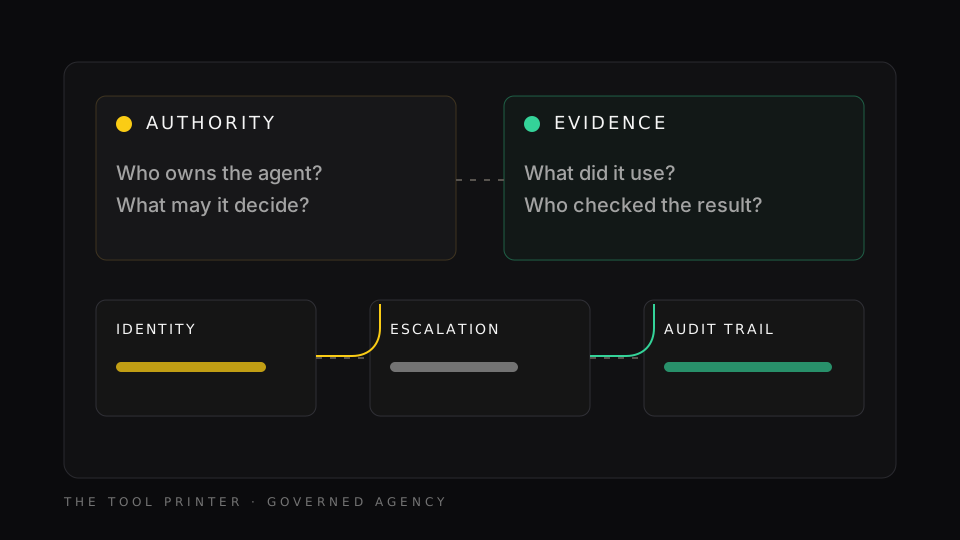
The desk, not the chatbot
The first wave of enterprise AI was access to models. The second wave was old school workflow automation. The next wave is governed agency: letting software act inside real business systems with bounded authority.
That product surface will not feel like a chatbot forever. It will feel more like a desk.
Not a metaphorical desk with a leather chair and a brass lamp. A real operating desk: identity, permissions, evidence, escalation, review, audit, and kill switches. The place where a company can see what its agents are doing and decide whether those actions deserve trust.
The desk makes the basics visible: agent identity, owner, permissions, human checkpoints, run history, and reconstruction. These details sound administrative until something breaks. Then they become the whole story.
The workplace agent changes the stakes
The most important enterprise agent will not be the demo agent sitting in a sandbox. It will be the workplace agent sitting near email, calendar, documents, CRM, support, finance, legal, chat, and internal knowledge.
Once an agent lives in that operating fabric, identity becomes the center of the design. A human employee has a role, a manager, access rights, device posture, geography, history, and an audit trail. An agent needs its own version of that control envelope.
Not because companies need more ceremony. Because without identity, there is no trust boundary.
An agent that drafts a memo is one thing. An agent that sends the memo, updates a renewal forecast, changes a CRM field, opens a ticket, pulls a contract clause, or schedules a client meeting is now acting inside the business. That action needs a name, a scope, and a record.
Know Your Agent
We already understand Know Your Customer. We understand vendor onboarding. We understand employee provisioning. We understand service accounts, least privilege, and approval workflows.
Agents need the same seriousness, without turning the whole thing into molasses.
Know Your Agent should establish identity, authority, authentication, delegation, provenance, verification, and revocation as operating facts. The business should know what the agent is, who owns it, what it may decide or execute, how it proves legitimacy, which evidence shaped the output, and how quickly its permissions can be narrowed or revoked.
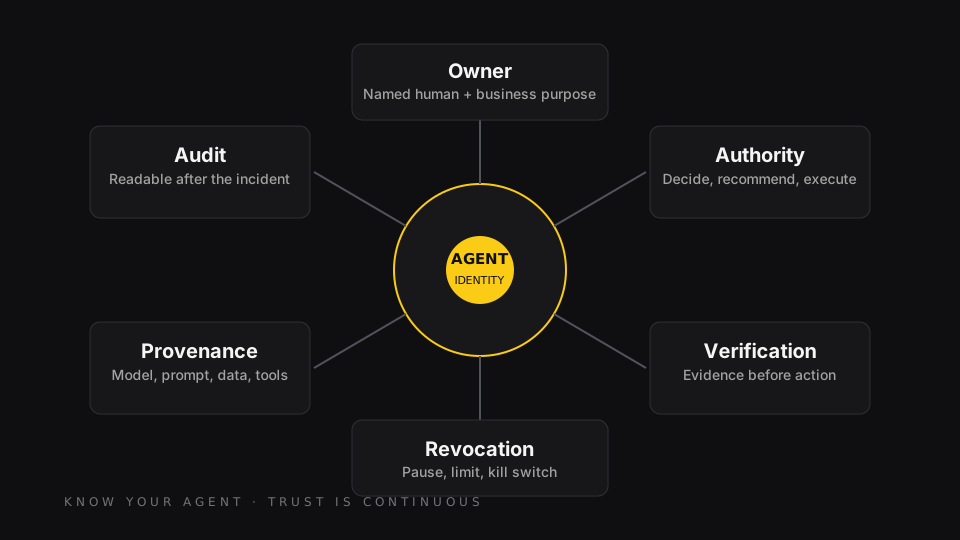
This is where AI governance becomes practical. Not a policy PDF. Not a committee that meets after the fact. A live control layer around acting software.
Authentication is not trust
Authentication proves an actor can enter the system. It doesn't prove the actor should do the thing it's about to do.
That difference matters.
An enterprise agent may authenticate successfully and still be outside its lane. It may have the right token but the wrong context. It may be acting under stale delegation. It may be using a tool for a purpose nobody approved. It may combine data that is harmless separately but sensitive together.
Trust is not a login event. Trust is continuous.
The governance desk has to see more than the user. It has to see the run: identity, permission, intent, context, tool calls, evidence, result, and exception trail.
Verification has to become part of the product
A lot of AI systems still treat verification like a polite suggestion. The model emits something. Maybe a person checks it. Maybe nobody does. In a low-risk writing workflow, that might be acceptable. In enterprise agency, it is not.
A governed agent should be able to show its work without forcing everyone to read a giant internal trace. The useful layer is operational evidence: inputs used, policies applied, tools called, human checkpoints, output state, and exception trail. A leader does not need every internal token. They need enough proof to understand what happened and decide whether the result deserves trust.
This is not compliance theater. It is the buyer's real question: can I trust the output enough to let it affect the business?
The anti-slop layer
AI slop is not just bad writing. It is output without accountability.
Slop is a confident answer with no provenance. A recommendation with no policy context. A summary that cannot be traced. A workflow that performs well in a demo but leaves no durable evidence. A newsletter that publishes because the machine can fill space, not because the item deserves attention.
The answer is not to slow everything down with manual review. The answer is to build loops where automation creates leverage and governance creates quality.
That is the shape I am building toward with The Tool Printer.
The system can watch the field continuously. It can pull from news, YouTube, LinkedIn/X, GitHub, research, and operator commentary. It can score items, draft briefs, compare angles, and learn from performance. But the loop still needs human judgment: approve, reject, correct, tune, and teach.
Human review should not be the bottleneck. It should be the governance function.
Performance loops need adult supervision
A/B testing is powerful. It is also a very efficient way to teach a machine to chase cheap attention.
If the only signal is engagement, the system will learn to produce engagement. That is not the same as insight. It is definitely not the same as trust.
The better pattern is performance plus editorial governance. The system should learn which sources repeatedly produce signal, which angles help a reader make a decision, which claims remain useful after the news cycle moves on, and which superficially clever posts are actually empty. The agent loop should learn from performance, but a human governance layer has to decide what kind of performance matters. Otherwise the system drifts toward whatever is easiest to measure.
The moat is trust infrastructure
The durable moat in enterprise AI won't be a prompt library, a wrapper around the latest model, or a nicely designed chat interface.
Those things matter, but they aren't enough.
The durable moat is trust infrastructure.
The winner will prove agent identity, permitted action, decision rationale, supporting evidence, review history, and the path to audit or reversal. That proof will matter more than another polished demo.
That is the governance desk.
It's part identity layer, part control plane, part editorial desk, part audit system.
Where this goes
The next generation of AI products will not be judged only by how impressive their outputs are. They will be judged by how governable those outputs are.
The serious systems will separate signal from slop, show provenance, respect identity and authority, learn from performance without becoming clickbait, and preserve human judgment at the moments where it matters. That is the shift: from AI as a content machine to AI as a governed operating system.
The enterprise winner is the party that can prove where judgment, liability, and escalation live after the agent starts acting.
That is why agency needs a governance desk.
Written by Geoff Hopkins for The Tool Printer. This is a working thesis, which means I expect it to get sharper as the system, the market, and the governance patterns keep moving.